"An Improved Approach to Graph Cannulation"
by William C Bauer, as published in D&T, September 2011
Wiley-Blackwell, Vol. 40 #9, © 2011, Wiley Periodicals
Summary of "An Approach to Graph Cannulation"
For over 50,000 dialysis patients, their primary “lifeline” is a graft.
By repeated cannulation, the graft material weakens.
In time, most grafts fail, and a new lifeline may be required.
Improved cannulation techniques can reduce these risks, and extend the longevity of a patient's graft.
One approach to accomplish this calls for a Cannulation Care Plan.
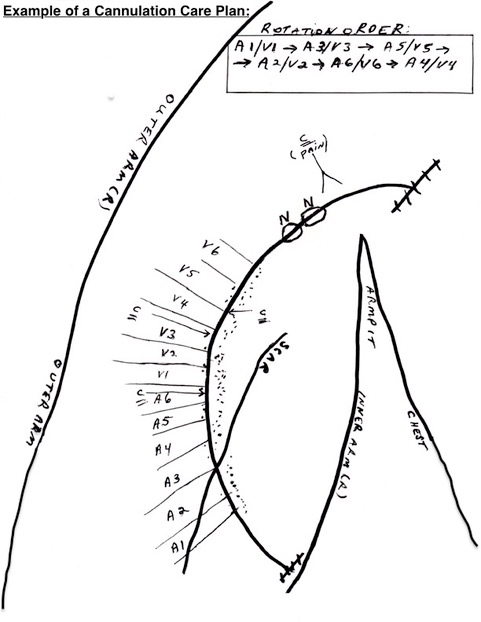
A Cannulation Care Plan is a graph or outline of a patient's shoulder or arm, including the graft and its characteristics, along with corresponding information, so that the sequence of cannulation sites is planned with rotation.
The Cannulation Care Plan is generated as follows:
An Outline of the graft is traced on transparency film. This graph includes:
Using the Outline, the Rotation Order (sequence of Interval IDs for cannulation, per treatment) is defined.
Example:
The image on the right is an outline of Sharry's right shoulder (right arm, armpit, and side of chest), the graft, its Alert Areas, and Interval IDs.
The “Interval IDs” on the A/V graft are sequentially labeled “A1 to A6”, “M” (midpoint), and, “V1 to V6”.
Therefore, I defined the Rotation Order as: "A1/V1 » A3/V3 » A5/V5 » A2/V2 » A6/V6 » A4/V4. Repeat." This Rotation Order allowed space (i.e., distance) between successive cannulation sites, in order to allow time for healing.
The resulting Outline and Rotation Order is called a "Cannulation Care Plan".
Upon each cannulation, I marked a "dot" on the Outline to show the even distribution of sites.
When a new "Alert Area" occurred, I would draw a new Cannulation Care Plan, along with a new Rotation Order.

Order a Start-up Kit
Practitioners, or a patients & companions, may request a single-patient "Start-up Kit" at my cost, which includes:
Limit one kit per practitioner or family. After you receive one, it's easy to get raw materials on-line to make kits yourself.